
If you’re tired of scrubbing mineral deposits off your faucets, dealing with spotty dishes, or stepping out of the shower with dry skin and dull hair, you may already be considering a water softener. But did you know you can enjoy the benefits of soft water without purchasing a traditional water softener, hauling heavy bags of salt, or maintaining your own equipment?
Water softener exchange tank service offers a convenient alternative to traditional water softening systems. Both options remove hardness minerals from your water, but they differ significantly in how they operate, how much maintenance they require, and how well they fit your lifestyle.
For homeowners and renters throughout North County, understanding these differences can help you choose a soft water solution that fits your household’s needs, budget, and available space.
What Is Water Softener Exchange Tank Service?
Water softener exchange tank service, also known as portable exchange tank service or soft water delivery service, is a professionally managed water treatment solution that provides softened water without requiring homeowners to regenerate or maintain their own water softening equipment.
A portable exchange tank contains a special ion-exchange resin that removes calcium and magnesium, the primary minerals responsible for hard water. As water passes through the tank, hardness minerals are exchanged for sodium ions, producing genuinely softened water.
Over time, the resin reaches its treatment capacity. Rather than regenerating the resin inside your home, your water treatment provider replaces the exhausted tank with a freshly regenerated one.
The used tank is transported back to a service facility where it is regenerated and prepared for future use.
With water softener exchange tank service from RWI Water Systems, you get the benefits of traditional water softening without having to manage the regeneration process yourself.
How Does Water Softener Exchange Tank Delivery Work?
One of the biggest advantages of portable water softener exchange tanks is their simplicity. Here’s what you can typically expect when you sign up for service.
1. Your household’s water softening needs are evaluated.
A water treatment professional evaluates your water hardness, household size, water consumption, and available space to determine the appropriate tank capacity and exchange schedule.
Proper sizing is important because a household with six people, for example, will likely have different soft water needs than a household with two.
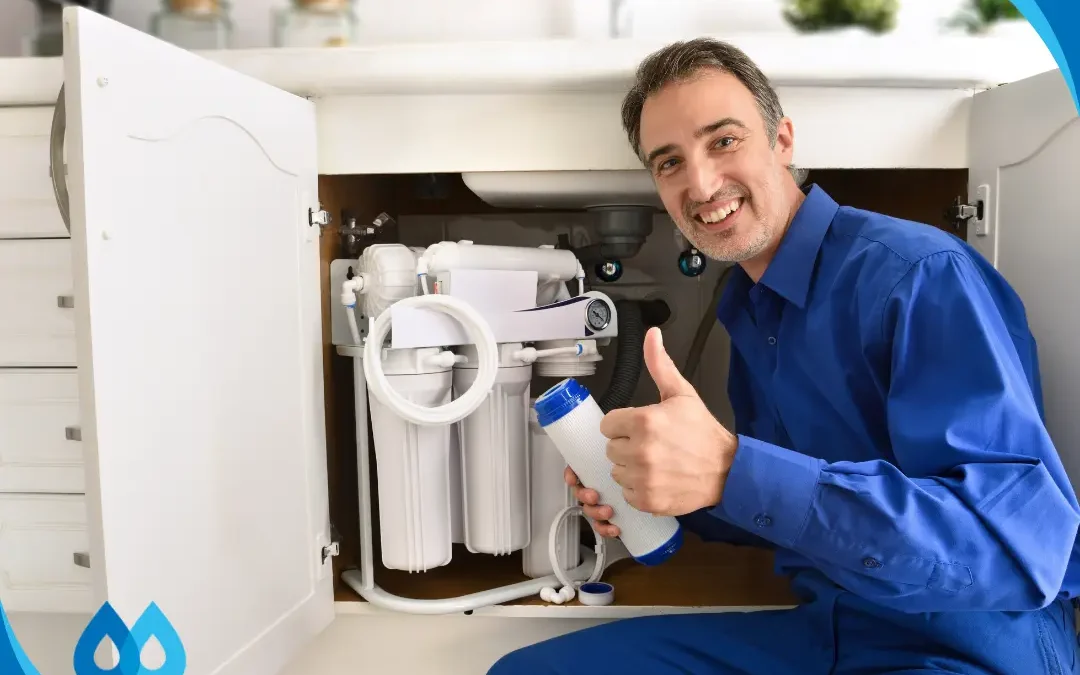
2. A portable water softener tank is connected to your home’s plumbing.
A freshly regenerated exchange tank is connected to your home’s water supply through an appropriate plumbing connection. As water enters your home and travels through the tank, hardness minerals are removed.
Although an initial plumbing connection is necessary, portable exchange tanks do not require the same regeneration-related infrastructure as traditional automatic water softeners.
3. Your tank is replaced on a recurring schedule.
An RWI Water Systems route driver delivers a replacement tank according to your household’s established service schedule.
4. Regeneration and equipment maintenance are handled off-site.
Your used tank is returned to a dedicated facility for regeneration. You don’t have to purchase salt, refill a brine tank, or monitor regeneration settings.
With a suitable installation location and access arrangements, tank exchanges can even take place while you’re away from home.
How Does a Traditional Water Softener Work?
A traditional automatic water softener also uses ion-exchange resin to remove calcium and magnesium from your water. However, instead of having the resin tank replaced periodically, the system regenerates its resin on-site.
Most automatic water softeners include:
- A resin tank that removes hardness minerals
- A brine tank that holds water softener salt
- A control valve that manages water flow and regeneration
- A drain connection for regeneration wastewater
- An electrical connection for electronic controls on most modern systems
During regeneration, a concentrated salt solution flushes accumulated hardness minerals from the resin, restoring its ability to soften water. The resulting wastewater is discharged through a drain.
Modern automatic water softeners can monitor household water consumption and adjust regeneration frequency to improve water and salt efficiency.
While these systems are highly effective, homeowners must still replenish the salt supply and arrange for periodic maintenance.
Water Softener Exchange Tank Service vs. Traditional Water Softener: A Side-by-Side Comparison
Both water softening options can effectively address hard water. The biggest differences involve convenience, installation, maintenance, and ongoing costs.
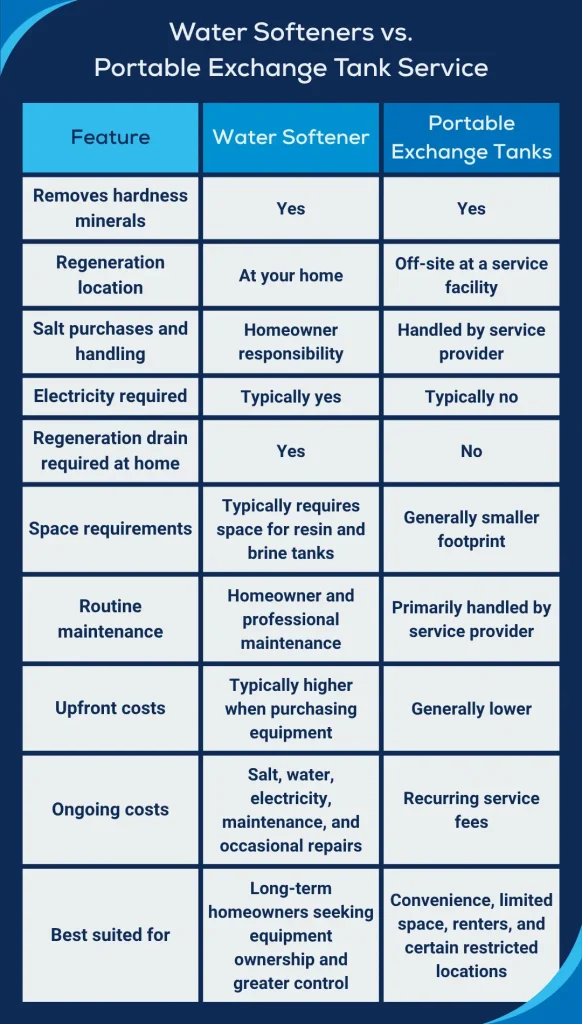
The best option ultimately depends on your household’s priorities rather than differences in the basic water softening process.
7 Benefits of Water Softener Exchange Tank Service
For many North County residents, portable exchange tanks offer practical advantages that make enjoying soft water easier.
1. No more buying or lifting heavy bags of salt
Traditional water softeners require a steady supply of salt for regeneration. Depending on your water hardness and usage, that may mean regularly purchasing, transporting, lifting, and storing heavy bags.
With water softener exchange tank service, your provider handles regeneration elsewhere. There’s no brine tank to refill and no need to store bags of salt in your garage.
This can be particularly beneficial for older adults, people with limited mobility, and anyone who simply wants one less household chore.
2. Less water softener maintenance
Traditional water softeners require occasional attention to keep them operating effectively. Salt bridges, clogged components, malfunctioning control valves, and regeneration problems can all interfere with performance.
Portable exchange tanks eliminate many of these maintenance responsibilities because they do not require an automatic regeneration system at your home.
Your service provider handles tank replacement, resin regeneration, and servicing of the exchange tanks.
Curious about what’s involved in maintaining a conventional system? Read our guide on how to easily maintain your water softener.
3. No regeneration wastewater discharged at your home
Automatic water softeners use water during regeneration to flush hardness minerals from the resin.
Because portable exchange tanks are regenerated off-site, your household doesn’t use additional water for this process or discharge regeneration brine into its wastewater system.
For California homeowners concerned about water conservation or local wastewater restrictions, this can be an important consideration.
Keep in mind that exchange tanks still require salt and water for regeneration at the service facility. The overall environmental impact depends on factors such as regeneration efficiency, wastewater management, and transportation.
4. Smaller space requirements
Not every home has a spacious garage, utility room, or dedicated water treatment area.
Portable water softener exchange tanks generally require less space because they don’t need a separate salt storage tank or on-site regeneration equipment.
This makes them an attractive option for smaller homes, townhomes, condominiums, and other properties where space is limited.
Your water treatment provider can help determine whether your available space, plumbing, and service access are suitable for an exchange tank.
5. Fewer installation requirements
Traditional automatic water softeners typically need access to a drain, an electrical outlet, and sufficient space for the necessary equipment.
A portable exchange tank generally needs only a suitable plumbing connection and an accessible installation location.
This may make exchange tank service possible in situations where installing an automatic water softener would be difficult, expensive, or impractical.
6. Lower upfront financial commitment
Purchasing a traditional water softener generally involves an upfront investment in equipment and installation.
With portable exchange tank service, you typically pay a recurring service fee instead of purchasing a complete automatic water softening system.
This can make soft water more accessible to households that want to avoid a large initial expense. However, you should compare costs over your anticipated period of use to determine which option offers the best long-term value.
7. Greater flexibility as your household needs change
Your water consumption may change over time. Children move out, family members move in, guests visit for extended periods, and work schedules change.
With portable exchange tank service, your provider can evaluate whether your tank capacity or delivery schedule needs to be adjusted.
That flexibility can be especially valuable when your long-term living arrangements or household water needs are uncertain.
Who Benefits Most From Portable Water Softener Exchange Tanks?
Although portable exchange tanks can work well for many households, they are particularly worth considering in the following situations.
Renters and people in temporary housing
If you don’t own your home or you expect to move within the next few years, purchasing a permanent water softening system may not make financial sense.
Portable exchange tanks provide a more flexible alternative, provided your landlord approves any necessary plumbing connections.
Older adults and people with limited mobility
Lifting heavy salt bags, checking equipment, and troubleshooting water softener problems can be physically demanding. A professionally managed exchange tank service removes many of these responsibilities.
Busy families and working professionals
Between work, school, family activities, and everyday household tasks, water softener maintenance may be the last thing you want to think about.
Scheduled soft water delivery allows you to enjoy softened water with minimal involvement.
Homeowners with limited installation space
If your property lacks room for a traditional two-tank system or doesn’t have a convenient drain or electrical connection, an exchange tank may be a more practical solution.
Residents in areas with water softener restrictions
Some California communities and wastewater authorities restrict self-regenerating water softeners because of concerns about salt discharge.
Portable exchange tanks may provide an alternative because regeneration takes place at a separate facility.
However, requirements vary by location, so it’s important to check applicable local regulations and HOA rules before choosing a system.
Homeowners replacing an aging water softener
If your current automatic water softener is nearing the end of its useful life, you don’t necessarily have to replace it with another automatic system.
Switching to portable exchange tank service may make sense if you’re tired of equipment repairs, want to eliminate salt handling, or would prefer professionally managed soft water.
When Is a Traditional Water Softener the Better Choice?
Despite the convenience of water softener exchange tank service, there are situations where purchasing an automatic water softener may be the better option.
A traditional water softener may be more appropriate if:
- You own your home and plan to live there for many years.
- Your household has particularly high or fluctuating water consumption.
- You prefer to own your water treatment equipment.
- You have adequate space, drainage, and electrical connections.
- You’re comfortable replenishing salt and arranging periodic maintenance.
- Local regulations permit automatic salt-based water softeners.
- You prefer a system that automatically regenerates in response to water consumption rather than relying on scheduled tank exchanges.
Today’s high-efficiency automatic water softeners can monitor usage patterns and regenerate as needed, making them a practical long-term investment for many households.
If you’re considering this option, our guide to choosing the right water softener size for your home explains why proper sizing is essential for reliable performance and efficiency.
Is Water Softener Exchange Tank Service More Affordable?
Water softener exchange tank service generally offers a lower upfront financial commitment, but it isn’t necessarily less expensive over the entire lifespan of a traditional water softener.
When comparing your options, consider the total cost rather than just the purchase price or monthly service fee.
The costs of owning an automatic water softener may include:
- Equipment purchase and installation
- Regular salt purchases
- Water and electricity used during regeneration
- Professional maintenance and servicing
- Replacement parts and repairs
- Eventual equipment replacement
The costs of portable exchange tank service may include:
- Initial plumbing or setup charges, if applicable
- Recurring exchange service fees
- Adjustments to service costs if your household requires larger tanks or more frequent exchanges
For some households, the predictability and convenience of a recurring service fee outweigh the potential long-term savings of owning a water softener.
Others may find that purchasing a system makes more financial sense over many years.
The experts at RWI Water Systems can help you compare your options based on your actual water hardness, household consumption, and budget.
Are Portable Exchange Tanks the Same as Salt-Free Water Conditioners?
No. Although portable exchange tanks eliminate the need to purchase and handle salt at home, they are not the same as salt-free water conditioners.
Portable exchange tanks use traditional ion exchange to physically remove calcium and magnesium from water. Salt is generally used to regenerate the resin at an off-site facility.
A salt-free water conditioner, on the other hand, typically changes how hardness minerals behave to reduce their tendency to form scale without actually removing them from the water.
If you want genuinely softened water without handling salt yourself, portable exchange tank service may be the better option.
If your primary concern is scale control without salt-based regeneration or additional sodium in your water, you may want to explore whole house no-salt water conditioners.
Frequently Asked Questions About Water Softener Exchange Tank Service
Do portable exchange tanks work as well as traditional water softeners?
Yes. Both systems use ion exchange to remove calcium and magnesium from water. When properly sized and maintained, portable exchange tanks can provide the same type of softened water as a traditional automatic water softener.
How often do water softener exchange tanks need to be replaced?
Exchange frequency depends on your water hardness, household water consumption, and tank capacity. Consequently, we offer various service schedules to accommodate different household needs.
Do I need to be home when my water softener tank is exchanged?
Not necessarily. If your exchange tank is installed in an accessible location and appropriate access arrangements have been made, an RWI Water Systems route driver can replace your tank while you’re away.
Do portable water softener tanks require electricity?
Generally, no. Because portable exchange tanks don’t regenerate automatically at your home, they typically don’t require electricity for their operation.
Can I run out of soft water before my next tank exchange?
It’s possible if your household uses more water than expected or your tank is undersized. Your water treatment provider can evaluate your usage and adjust your tank capacity or exchange schedule if necessary.
Can I switch from a traditional water softener to exchange tank service?
Yes, in many cases. A water treatment professional can inspect your existing plumbing, available space, and water treatment needs to determine what’s required to make the switch.
Does water softener exchange tank service provide filtered drinking water?
Water softening primarily addresses calcium and magnesium. It is not designed to remove chlorine, microorganisms, or most other drinking water contaminants. Depending on your water quality concerns, you may benefit from an additional drinking water filtration system.
Is water softener exchange tank service worth it?
For households that prioritize convenience, minimal maintenance, lower upfront costs, and freedom from handling salt, exchange tank service can be an excellent investment. Homeowners who prioritize equipment ownership and long-term costs may prefer a traditional automatic water softener.
Enjoy the Benefits of Soft Water Without the Hassle With RWI Water Systems
Hard water shouldn’t mean spending extra time cleaning mineral deposits, worrying about scale buildup inside your appliances, or constantly maintaining water treatment equipment.
Whether you’re looking for a convenient alternative to your aging water softener, exploring water treatment options for a rental property, or simply tired of hauling heavy bags of salt, RWI Water Systems can help.
Our water softener exchange tank service allows you to enjoy the everyday benefits of soft water, including:
- Less mineral buildup on faucets, showerheads, and fixtures
- Reduced scale formation inside plumbing and water-using appliances
- Better soap and detergent performance
- Softer-feeling skin, hair, and laundry
- Less time spent cleaning hard water residue
- Convenient, professionally managed water softening
Family-owned and operated since 1964, RWI Water Systems understands the unique water quality challenges facing North County residents. We proudly serve homeowners throughout Vista, Oceanside, Carlsbad, San Marcos, Escondido, Fallbrook, Bonsall, La Costa, Camp Pendleton, and surrounding communities.
We offer portable exchange tanks, traditional automatic water softeners, and whole house no-salt conditioners because we believe the best water treatment solution is the one that fits your home, lifestyle, and budget.
Ready to enjoy soft water without the hassle of maintaining a traditional water softener? Contact us today to learn more about our water softener exchange tank service and find the right soft water solution for your North County home.